Teaching Chemistry as Climate Action: Inside Jillian Blatti’s Classroom
Wayfinder Society is for environmental educators who believe in the power of collective action. It is an online platform hosting a robust offering of classroom and teaching resources that makes it easy for educators to create a fun, dynamic, and engaging classroom and to inspire their students through environmental awareness and action. Every other month, we highlight an educator in our network.
Jillian L. Blatti, Ph.D., is an Associate Professor of Chemistry and Environmental Sciences at Pasadena City College, where she leads undergraduate research at the intersection of chemistry, environmental science, and justice-centered education. Her work empowers students with the knowledge, skills, and agency to understand complex environmental challenges including plastic pollution, climate change, ocean acidification, sustainable energy, and more.
Jillian’s academic journey bridges cutting-edge science with inclusive pedagogy. As a graduate researcher at University of California, San Diego and CAL-CAB, she engineered fatty acid biosynthesis in microalgae for sustainable bioenergy while simultaneously developing STEM curricula for students historically excluded from science spaces that engages them with these modern technologies and prepares them for careers in sustainability.
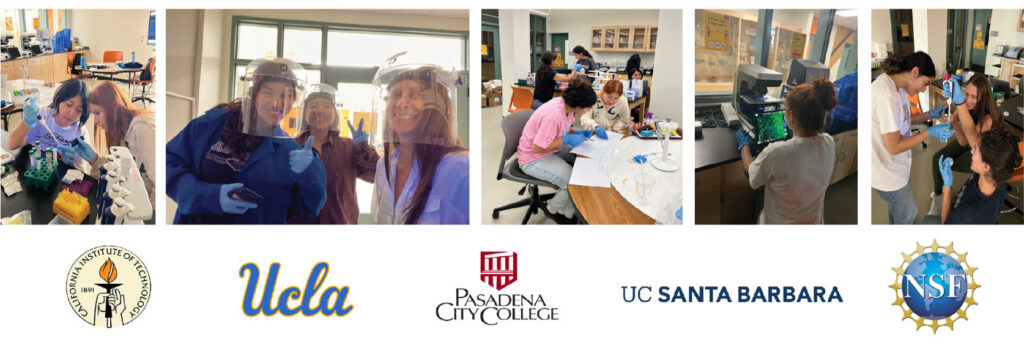
Today, she continues this systems-level approach as a Co–Principal Investigator on a National Science Foundation (NSF) Future Manufacturing grant, collaborating with Caltech, UCLA, and UCSB to advance sustainable, nucleic acid–based manufacturing technologies. Jillian and a dedicated group of her students called the PCC nanostars are working on a synthetic biology research project to fabricate materials of the future using DNA nanotechnology. Learn more about their work on their YouTube channel, where you can find publications of their research and video tutorials about to make your own DNA nanostructures!
What truly sets Jillian apart as an educator is how she brings science to life for students through Action for Climate Empowerment (ACE), community-based learning, and creative expression. This fall, she published Action for Climate Empowerment through Art–Science, Community-Based Learning and Sustainability Outreach in the Journal of Chemical Education, outlining how educators can integrate art–science projects, authentic research, and sustainability outreach to foster empathy, creativity, and climate action. From bioplastics and algae biodiesel to DNA nanotechnology and natural paint-making, her classrooms demonstrate how chemistry (and art!) can be a tool for environmental justice and liberation.
In her Chemistry & the Environment (ENVS3) course, Jillian directly integrates Wayfinder Society resources, including screening The Story of Plastic and the Classroom Experience Guide to help students process the insightful information from the film. Her students then move from reflection to action through hands-on, community-based research in the Los Angeles Watershed.
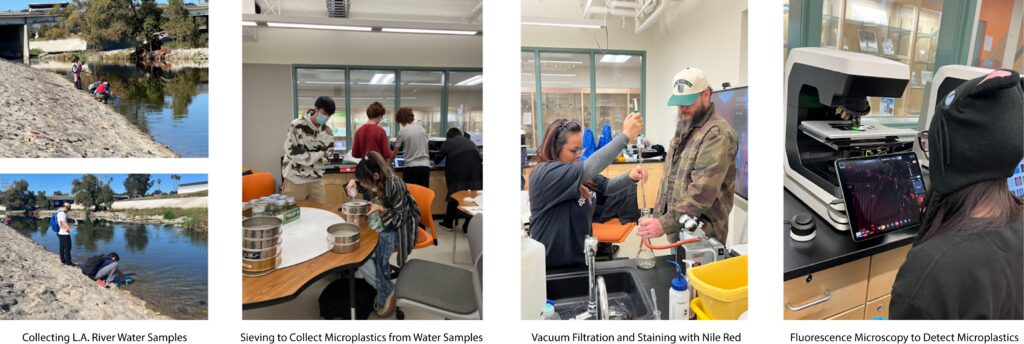
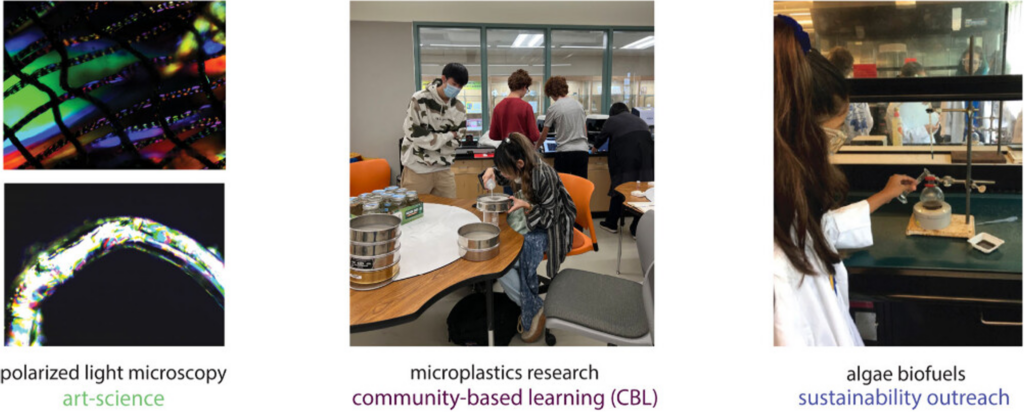
A cornerstone of this work is Jillian’s long-standing partnership with Algalita’s sister nonprofit, the Moore Institute for Plastic Pollution Research (MIPPR), one of the first laboratories in the world accredited to test microplastics in drinking water. Through this collaboration, PCC students conduct trash audits along the Los Angeles River, analyze river and tap-water samples using standardized microplastics protocols, and work with real scientific data generated through MIPPR’s lab infrastructure. Afterward, they translate their findings into letters to California lawmakers in hopes of furthering advocacy for stronger policies to address microplastics contamination. The figure below shows Jillian’s students collecting samples from the L.A. River and analyzing the water samples for microplastics in the chemistry laboratory!
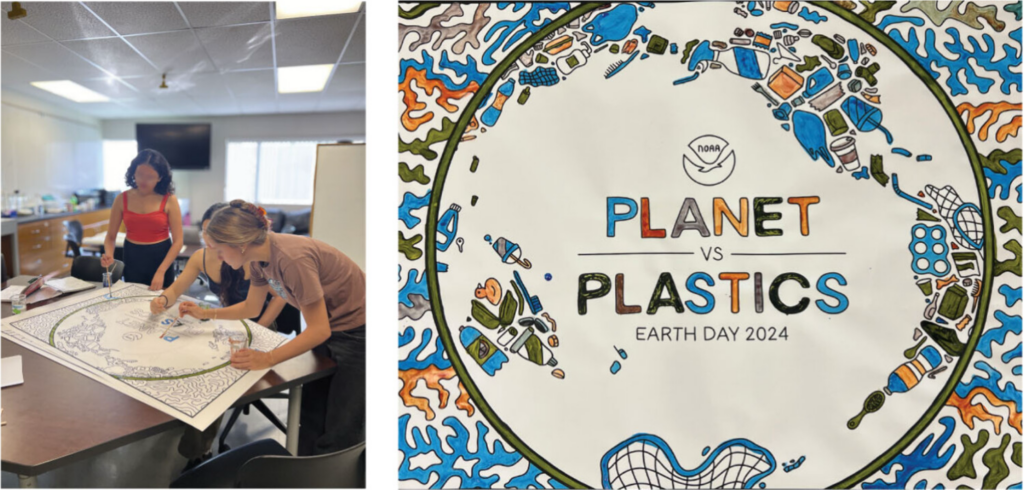
To advocate for the environment and to inspire creative expression, Jillian’s students engage in art—science projects. For instance, her students created environmentally themed art using paints from natural resources they crafted using Green Chemistry (no petroleum feedstocks required!). In the image below, ENVS3 students are painting an Earth Day poster using natural paints they made from extracted beta carotene (orange paint), spirulina algae (blue paint), green microalgae (green paint from chlorophyll!), various flowers, cabbage, and raspberries (pink paints). Pigments were combined with either egg yolk or egg white to make paint, and beautiful works of art were created by students to educate others and bring awareness to environmental issues.
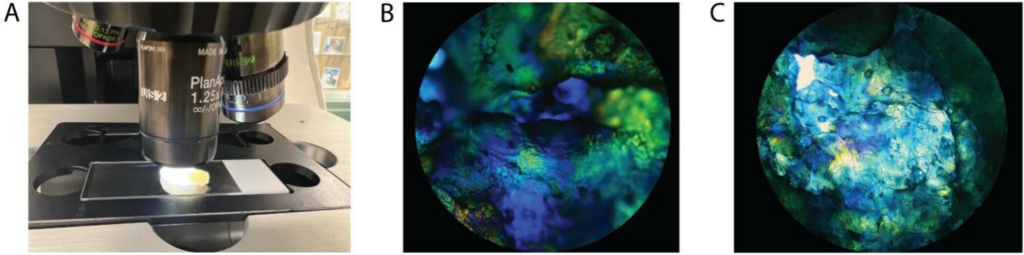
In another innovative art–science project, Jillian’s students create bioplastics from natural materials like milk and lobster shells, then examine their structures using microscopy. This exploration goes beyond analysis: students experiment with different illumination techniques to reveal unexpected colors, patterns, and forms that transform microscopic data into striking works of art invisible to the naked eye. Through this hands-on process, students discover how bioplastics embody the powerful intersection of green & sustainable chemistry and creative expression, while introducing them to sustainable plastic alternatives!
This blend of hands-on science, community partnership, and civic engagement mirrors Algalita’s core goals: connecting people to place, grounding learning in real-world environmental systems, and empowering the next generation of leaders to work toward a world where plastic pollution is unthinkable. Jillian’s work shows what’s possible when education becomes a platform for curiosity, creativity, and collective action.
Through educators like Jillian Blatti, the Wayfinder Society continues to grow a global community of teachers who are not only teaching about plastic pollution and climate change but equipping students to imagine and build a more sustainable future.
______________________________________
Publications for the PCC Nanostars Undergraduate Research group that Dr. Jillian Blatti leads:
- https://micronanoeducation.org/journal/volume-4-issue-1/investigating-substrates-amplifu-red-and-abts-22-azino-bis3-ethylbenzothiazoline-6-sulfonic-acid-in-the-colorimetric-detection-of-dnazyme-activity-localized-to-dna-condensates/
- https://micronanoeducation.org/journal/volume-5-issue-1/exploring-toehold-mediated-strand-displacement-as-a-strategy-to-program-dnazyme-catalyzed-peroxidation-localized-to-dna-condensates/
- https://micronanoeducation.org/journal/volume-5-issue-1/molecular-visualization-in-nanotechnology-education-research-and-outreach-simulating-catalytic-dna-nanostars-using-oxdna/
- PCC nanostars YouTube page! https://youtube.com/@pccnanostars6817?si=ojDqTJ-9aUz8QA3D
- PCC Microscopic Art Instagram: @pcc_microscopic_art
Dr. Jillian Blatti’s curriculum papers and activities:
- Algae Biodiesel Activity: https://pubs.acs.org/doi/full/10.1021/ed200098c
- Sustainable Paints Activity: https://pubs.acs.org/doi/10.1021/acs.jchemed.6b00591
- Action for Climate Empowerment: https://pubs.acs.org/doi/10.1021/acs.jchemed.4c00458
- Systems Thinking in Chemistry Education: https://pubs.acs.org/doi/10.1021/acs.jchemed.9b00318
- How to Simulate DNA nanostars: https://www.youtube.com/watch?v=_FrL3UHvhdA&t=1s
- Developing Professional Workforce Skills: https://pubs.acs.org/doi/10.1021/bk-2020-1365.ch016
- Systems thinking in environmental science education in collab with Caltech sustainability science and engineering: https://pubs.acs.org/doi/full/10.1021/acs.jchemed.9b00318
- Artistic anthocyanins, polarized light microscopy, microplastics research: https://pubs.acs.org/doi/10.1021/acs.jchemed.4c00458
